Japan
You Only Live TwiceJapan is the setting in which James Bond’s improbable assignment becomes a confrontation with the enemy who killed Tracy. Its narrative geography runs from the secrecy of Tokyo to Fukuoka and the southern island of Kyushu, where local authorities contend with a fortress-like estate and the deaths drawn to it. Japan is not merely a distant destination for British intelligence: it is where Tiger Tanaka’s authority, Bond’s obligations, and Blofeld’s carefully prepared refuge converge.
A covert destination
M. tells James Bond that he will leave for Japan within a week, as an acting promotion transfers him to the Diplomatic Section. The arrangements are handled personally by the Chief of Staff, and even M.’s secretary is kept uninformed; there is no case file. The absence of ordinary paperwork makes the assignment’s importance tangible while also establishing the secrecy surrounding Bond’s journey. M. presents the task as one with little prospect of success, a judgment that turns the promotion into something more complicated than a reward.
Japan is thus introduced as the destination of a mission whose real nature is initially concealed. The journey is not simply an official posting: the secret arrangements and Bond’s sudden change in standing prepare for a deployment in which conventional duties will give way to personal danger. The contrast between an invisible case at headquarters and the vast, physical obstacles Bond later faces in Kyushu defines the mission’s scale in two different ways.
Tokyo, Tiger Tanaka, and obligation
In Tokyo, Japan’s intelligence world is embodied by Tiger Tanaka, head of the Japanese Secret Service and Bond’s close operational counterpart. At a gathering where the geisha Trembling Leaf kisses Bond amid the encouragement of the company, Tiger ends the levity by laying aside his cigarette holder and announcing a challenge. The scene places ceremonial hospitality, playful teasing, and the assertion of authority in the same room. Bond answers with jokes about sake and Western instinct; Tiger counters by correcting his error about Ming porcelain and warning him against underestimating the drink. Their exchange makes their differences part of an established familiarity rather than a barrier to cooperation.
The lightness has a limit. After the immediate conversation turns to Tiger’s problem, he orders Bond to leave the next day on the twelve-twenty train from Tokyo main station. Bond’s destination is Fukuoka, and he is told not to return to his hotel or see Dikko: from then on, he is under Tiger’s personal orders. Tiger invokes Bond’s earlier offer to perform personal services in exchange for MAGIC 44. Japan’s role in the mission is therefore bound to an obligation Bond himself accepted. The change from drinking-room banter to an unambiguous command marks the point at which hospitality gives way to service.
Fukuoka and the Castle of Death
In Fukuoka, Tiger visits the local CID headquarters, a stern yellow-brick building derived from German architectural style. He identifies it as a former Kempeitai headquarters, linking the present investigation to the building’s wartime institutional history. Superintendent Ando receives Tiger formally; Bond observes that Tiger addresses him with respect. Their meeting is practical and urgent: Ando produces an aerial mosaic of the Castle of Death and the surrounding country, and explains that approaches through the marshes are difficult to control. People seeking death pay local peasants to guide them through, while openings in the estate walls are repeatedly changed and kept accessible. Guards cannot close the problem by watching known breaches, because other routes are made available. Twenty bodies have reached the mortuary in a single week, and Ando is considering resignation.
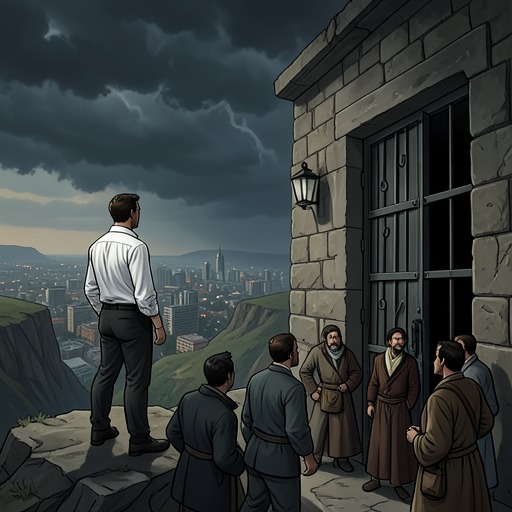
The map makes the Castle of Death appear less like an isolated building than a defended landscape. Its estate occupies a promontory projecting into the sea from a rocky coast. A high cliff has been faced with giant stone blocks down to the waves, forming a continuous wall with gun-ports and irregularly placed tiled watchtowers. Inside, a drop leads into a wooded park threaded with streams and a broad lake; steam rises from the water and from parts of the grounds. At the rear, a lower wall separates the property from the countryside and provides the route used by those entering to die. The castle itself rises five storeys, with glazed, winged roofs, dolphin-shaped finials, balconies, turrets, and gazebos. Its black surfaces and patches of gold give it the appearance of a theatrical stronghold. Studying the photograph through a magnifying glass, Bond finds little to suggest an easy approach and concludes that the estate is a fortress, not simply a castle.
Refuge, revenge, and narrative significance
The setting’s danger is inseparable from Blofeld’s choice of concealment. James Bond recognizes him as the founder of SPECTRE, the man wanted by the police of NATO countries and the murderer of Tracy, Bond’s wife for less than a day. Under the identity of the Swiss Doctor Shatterhand, Blofeld poses as a wealthy botanist. Bond imagines how gifts of rare plants and funding for expeditions could have helped make the cover credible, while concealing the purpose of the garden. In Japan, as the novel frames it, Blofeld has fashioned that garden into a trap for people who want to die, exploiting the country’s high suicide statistics and appetite for the bizarre and terrible as part of his refuge.
Japan also supplies Blofeld with an operational network: Bond’s assessment connects the careful execution of the scheme to the Black Dragon Society. The threat is therefore not confined to the castle’s walls. It extends through the local routes that bring people to the estate, the guards who manage its openings, and the organization involved in Blofeld’s plans. Against that elaborate machinery, James Bond prepares with limited equipment: ninja gear, black flippers, a small supply of meat, benzedrine tablets, water, a pocket knife, and a thin steel chain. He understands the mission as a blood feud as well as a duty, and expects surprise to matter more than force. Japan’s decisive significance is this convergence: a clandestine assignment becomes a direct pursuit of Blofeld, while the apparently remote setting reveals itself as the carefully engineered stage for the conflict.